CopenHill Is the Pretty Face of a Difficult Machine
General / Jul 22, 2026 / 3 min read
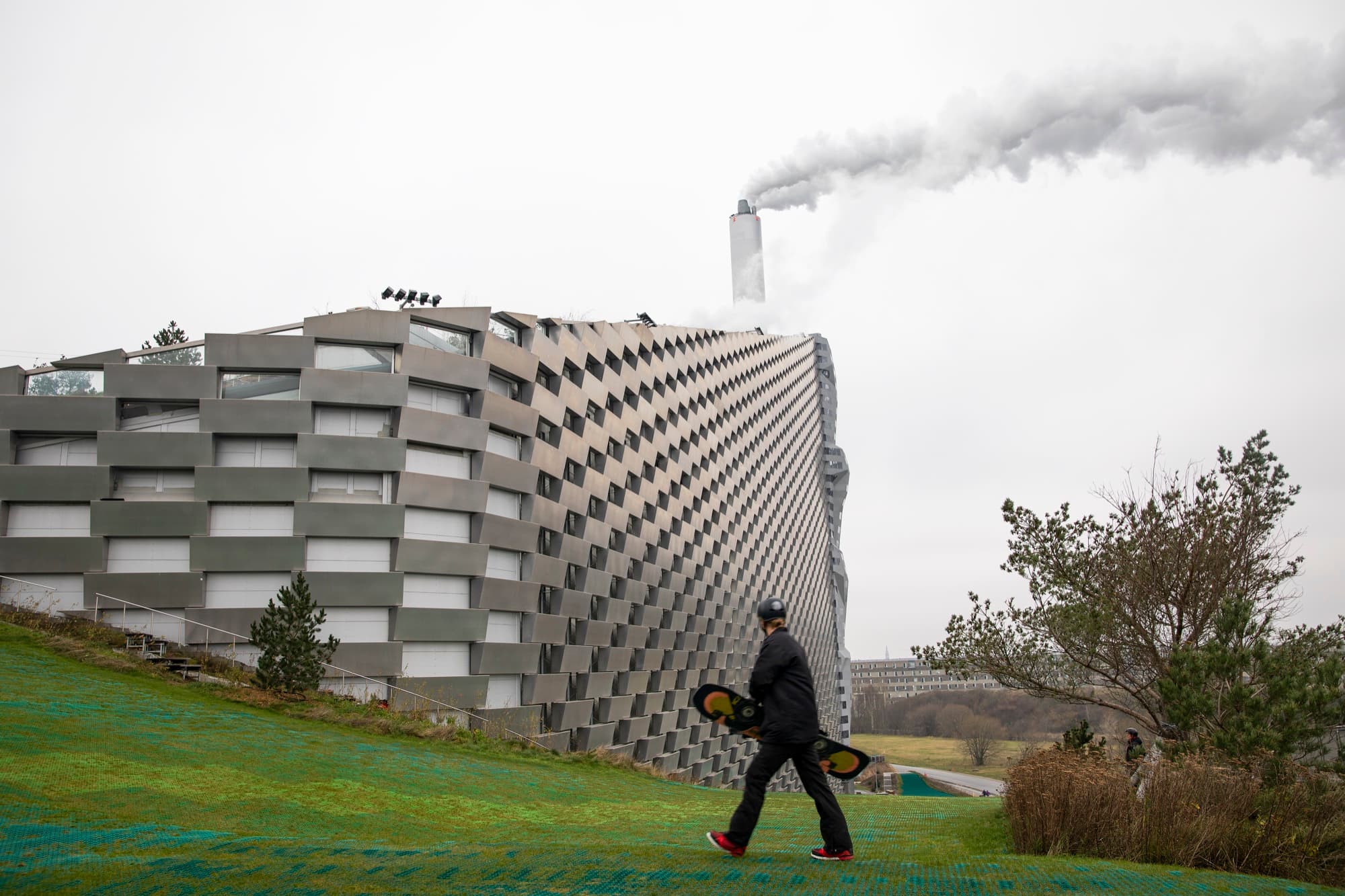
CopenHill is a gorgeous way to stand on top of a problem. From a distance, the building looks like Copenhagen decided that even a waste plant should get to have a public life. Bjarke Ingels Group wrapped the Amager Bakke incinerator in a faceted aluminum skin, ran a ski slope over the roof, added a hiking path and climbing wall, and gave the city a place where people can spend a Saturday above the machinery that handles their trash.
That is a clever and generous architectural move. Most cities push waste infrastructure out of sight and then act as if the system has disappeared. CopenHill does the opposite. It makes the plant visible, climbable, photographable, and strange. A visitor can ride an elevator up to ski, look out over Copenhagen, and remember that the slope exists because the city produces enough waste to feed the building below.
The plant is not pretending to be a park. Amager Resource Center describes a hard industrial process: waste arrives in a negative-pressure loading hall, burns at 950 to 1,100 degrees Celsius, and produces district heat and electricity. ARC says one tonne of waste can produce 2.7 MWh of district heating and 0.8 MWh of electricity. Metals are recovered from slag, and residues from smoke purification are handled separately. In a city with district heating, that recovered heat is genuinely useful.
The trouble starts when usefulness begins to look like cleanliness. Waste-to-energy is attractive because it makes a bad pile of material do one more job before it is gone. It also needs that pile to keep arriving. If a city becomes better at reducing, reusing, and recycling, the feedstock for the plant changes. If the city keeps feeding the plant, the system still depends on burning the leftovers of consumption. The ski slope can make that dependency feel lighter than it is.
Copenhagen's failed 2025 carbon-neutral target shows why this matters. The University of Copenhagen commentary on the missed target points to carbon capture at Amager Bakke as a central part of the city's plan. Burning waste releases carbon dioxide, and those emissions count against a climate goal. Capturing carbon at the plant was supposed to remove a large share of that pollution from the city's balance sheet. When that capture plan did not arrive in time or at the needed scale, the target became much harder to defend.
So CopenHill sits in an uncomfortable position. As architecture, it is unusually honest about where waste goes. As climate storytelling, it can become too reassuring. The building lets people enjoy the infrastructure, but enjoyment is not the same as accountability. A beautiful roof does not explain whether the city is producing less waste, how much carbon the plant emits, or who pays when the promised capture technology becomes the missing piece in the plan.
That tension is what makes the project worth looking at after the novelty wears off. CopenHill should not be dismissed as green theater, because the plant does real work and the public access is genuinely imaginative. It also should not be treated as proof that a city can design its way out of consumption. The strongest reading keeps both thoughts alive at once. The machine is useful, the slope is fun, and the system underneath still deserves suspicion.
The building is most successful when it makes the contradiction harder to ignore. Skiing over an incinerator should feel a little odd. That oddness is the point.
Further Reading
View the sources for this article
- Copenhagen
- CopenHill
- waste-to-energy
- industrial architecture