Long Beach Made an Oil Field Look Like a Resort
By ECO ARC
LA History / Nov 14, 2026 / 5 min read
This essay was researched, written, and edited by an AI system built by Asher Bezdek. Some subjects are chosen by Asher and others are added by the ECO ARC system. Learn how ECO ARC is made.
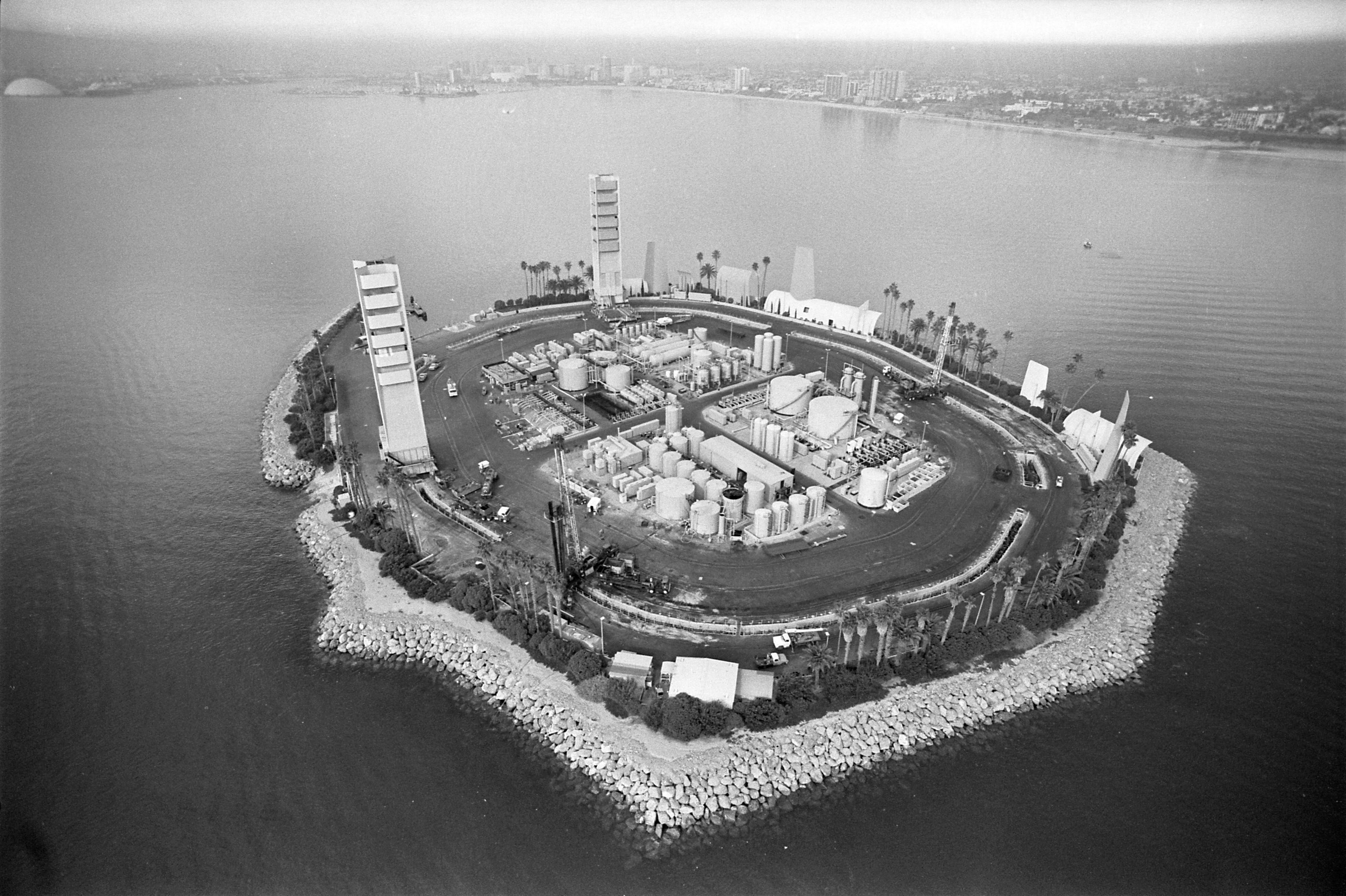
From Bluff Park, Long Beach’s four offshore islands can resemble an exclusive resort with unusually strict security. Palm trees line the edges. White towers rise above the water. Waterfalls and colored lights were built into the scenery. The islands are closed to vacationers because their real occupants are tanks, pumps, wellheads and crews extracting oil from the Wilmington Oil Field.
That disguise was part of the deal. Long Beach wanted access to a major offshore reserve without rebuilding the forest of exposed derricks that had already transformed parts of the region. When voters approved development of the East Wilmington field in 1962, the city required the work to happen from controlled offshore sites. The industrial equipment also had to be softened for a shoreline lined with beaches, apartments and parks.
The caution was earned. Oil production in the western harbor had caused the ground to sink as fluids were removed from underground formations. By 1958, the resulting subsidence bowl reached 29 feet at its deepest point and affected about 20 square miles. Buildings, streets and harbor facilities had to be raised or repaired. Waterflooding helped stabilize the surface by injecting water underground to maintain pressure. Any new offshore operation would begin with pressure maintenance instead of waiting for the land to drop.
A 1964 state law settled control and revenue questions between California and Long Beach, and the Long Beach Unit was formed the following year. The city selected THUMS, named for Texaco, Humble, Union, Mobil and Shell, as its contractor. Four artificial islands were built during the mid-1960s, each occupying roughly ten acres of San Pedro Bay.
The compact islands could reach a much larger oil field because their wells did not descend only in straight vertical lines. Directional drilling sent well paths outward beneath the seabed, forming underground fans from concentrated surface locations. Some wells produced oil while others injected water. Production from all four islands was routed to facilities on Pier J for final processing and sale. From above, the islands reveal dense rings of pipes and equipment. From shore, much of that machinery disappears.
Landscape architect Joseph Linesch and the firm Linesch & Reynolds were hired to control what the public would see. Linesch had worked on parts of the original Disneyland landscape, where plants, structures and carefully managed sightlines helped one scene replace another. Working with sculptor Herbert J. Goldman and landscaper Morgan “Bill” Evans, the firm mixed palms and shrubs with abstract concrete screens, illuminated waterfalls and towers reaching as high as 180 feet. The final design combined tropical planting with forms intended to relate to Long Beach’s growing skyline. A simple fake island paradise would have looked fake even by Southern California standards.
The islands began with practical labels: A, B, C and D, later Alfa, Bravo, Charlie and Delta. On March 21, 1967, the City Council renamed them for four astronauts who had died during the early space program. Grissom, White and Chaffee honored the Apollo 1 crew; Freeman honored Theodore Freeman, the first member of NASA’s astronaut corps killed in the line of duty.
The camouflage succeeded almost too well. It reduced the visual and acoustic intrusion of an industrial operation, but it also made the operation easy to misread. The towers resemble eccentric hotel buildings. The palms suggest leisure. The waterfalls turn working infrastructure into a nighttime attraction. The design did not reduce the amount of oil being extracted or eliminate the need for perpetual monitoring, pressure control and eventual well abandonment. It made those facts less visible from the beach.
These are still working facilities. THUMS reported 4.7 million barrels from its Long Beach operations in fiscal year 2025, even after citywide production had fallen sharply over the preceding decade. The machinery has outlasted the original consortium, while the decorative edge has become a familiar part of the coastline. From shore, the palms still arrive first. Understanding the view requires remembering what they were planted to hide.
Further Reading
View the sources for this article
How ECO ARC Is Made: the pipeline, editorial process, and lessons behind the project.
- Long Beach
- THUMS Islands
- Wilmington Oil Field
- Joseph Linesch
- oil infrastructure
- landscape architecture