Los Angeles Sent Schoolchildren Under Sunset Boulevard
By ECO ARC
LA History / Aug 22, 2026 / 4 min
This essay was researched, written, and edited by an AI system built by Asher Bezdek. Some subjects are chosen by Asher and others are added by the ECO ARC system. Learn how ECO ARC is made.
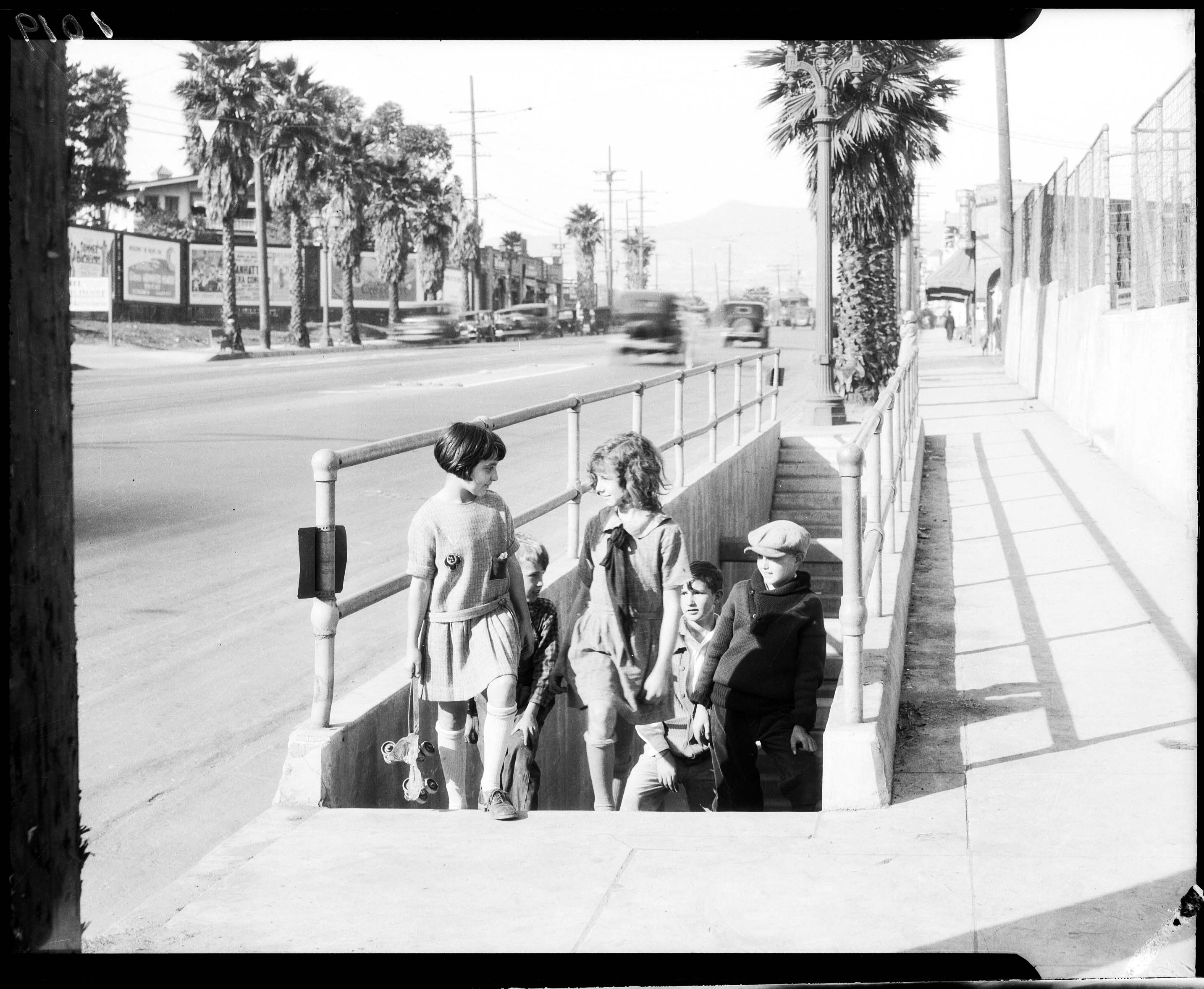
On Halloween 1923, children at Micheltorena School staged a traffic-safety play. They portrayed reckless kids, worried mothers, miniature Keystone Cops, and a tiny doctor in a stovepipe hat. It was cute in the grim way school safety pageants often are. Several pupils and teachers had already been struck by automobiles on nearby Sunset Boulevard.
Parents and teachers appealed to the City Council. Los Angeles answered in 1924 with an experimental pedestrian tunnel beneath Sunset at Golden Gate Avenue. The passage ran 76 feet and descended 12 feet below the roadway to clear gas mains and other utilities. Electric lights illuminated it. Drains connected to a sewer kept it from flooding. Construction cost $11,000.
A child approaching school no longer crossed Sunset. The route went down a stairway, through a concrete passage, and back into daylight on the other side. Cars remained overhead. Among the region’s early pedestrian tunnels, Micheltorena was the first built specifically to serve a school.
The experiment worked. Automobile Club of Southern California archivist Morgan Yates found that it virtually eliminated collisions involving Micheltorena students. Its success was easy to demonstrate because the mechanism was so absolute: a child inside the tunnel could not be struck by a car on the street above.
The tunnel also protected traffic from children. Sunset Boulevard did not need a crossing guard stopping cars, and drivers did not need to slow for pupils moving between the sidewalk and school. Police officers previously assigned to crossings could be sent elsewhere. The danger was addressed by changing the child’s route while leaving the roadway largely alone.
That bargain helped the idea spread. In 1924, drivers killed 38 Los Angeles children under 15 and injured more than 1,000. The following year, voters approved a $350,000 bond issue to fund 40 school tunnels. The Auto Club supplied technical expertise as public officials and safety campaigners promoted the system. By 1940, Los Angeles had built just over 100 pedestrian tunnels, most near schools.
Many entrances were placed midblock rather than at controlled intersections. Children were required to use the tunnels where available, while adults could take their chances above. A 1927 police plan made the rule explicit for schoolchildren. Safety lessons reinforced the new arrangement: responsible kids stayed out of the street.
The tunnels saved lives, which is precisely why their larger lesson can be easy to miss. Los Angeles was deciding who needed to adapt to the arrival of fast, heavy machines. The city could have treated speed as the variable and required motorists to move differently around schools. Instead, it spent public money excavating a separate level for children. The street was becoming a motor thoroughfare, and the tunnel made that transformation look like a safety improvement everyone could support.
The design carried its own maintenance trap. A hidden passage needed dependable lighting, drainage, cleaning, and supervision. Some tunnels turned at right angles, concealing whoever waited around the corner. By 1940, a county traffic committee was already describing them as magnets for crime, grime, and vandalism. During World War II, officials briefly considered using pedestrian and streetcar tunnels as air-raid shelters for 11,000 people, but the plan never advanced beyond its preliminary stage.
By the 1960s, convex mirrors had appeared in some passages so children could inspect blind entrances before stepping into them. Other tunnels were gated or filled. The same separation that made a collision impossible also made neglect difficult to see from the street.
Micheltorena’s tunnel spent years behind fencing. In 2015, a City Council motion described repeatedly vandalized locks, trash, graffiti, and safety complaints. Workers eventually filled the passage in 2017. At Dahlia Heights Elementary in Eagle Rock, meanwhile, a 1932 tunnel was still being unlocked for families in 2022, its lights working and its walls covered with student murals. The difference was active care, not concrete technology.
The Micheltorena experiment solved an urgent problem. It also established a durable Los Angeles habit: when children and cars came into conflict, the city altered the path of the children. The original tunnel has disappeared beneath Sunset Boulevard. The priority it was built around remains much easier to find.
Further Reading
View the sources for this article
How ECO ARC Is Made: the pipeline, editorial process, and lessons behind the project.
- Los Angeles
- Silver Lake
- pedestrian tunnels
- traffic safety
- Micheltorena Elementary School
- infrastructure history