Los Angeles Sold Neighborhoods With Custom Streetlights
By ECO ARC
LA History / Sep 30, 2026 / 4 min read
This essay was researched, written, and edited by an AI system built by Asher Bezdek. Some subjects are chosen by Asher and others are added by the ECO ARC system. Learn how ECO ARC is made.
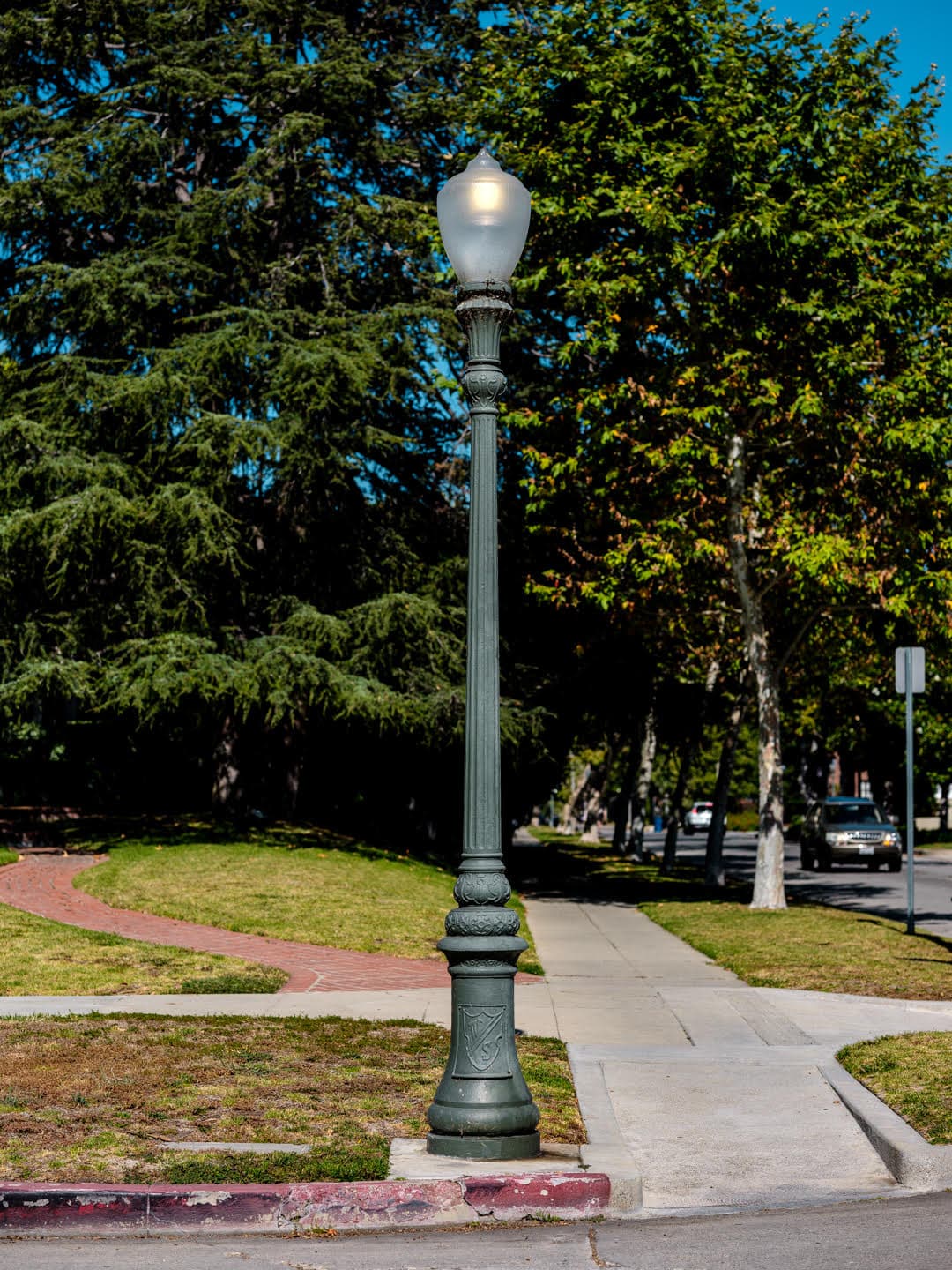
On Plymouth Boulevard in Windsor Square, the streetlights carry the neighborhood’s initials. A small “W/S” shield is cast into each dark-green base, beneath fluting, leaves and an acorn-shaped globe. The fixture looks like civic heraldry because that is basically what it was. When Windsor Square lots went on sale in the 1910s, the lamp appeared in advertisements alongside concrete streets, landscaped parkways and buried utility lines. Electric light was one more proof that this new subdivision had arrived preloaded with prestige.
The original 1914 version was even showier: a crossbar held three rectangular lanterns. A Los Angeles Times advertisement claimed $500,000 had been spent on improvements and pictured the pole as part of the sales pitch. The lanterns were replaced by a single acorn globe during the 1920s, but the monogram stayed. Houses changed owners, cars replaced streetcars and the lamp kept quietly announcing the tract.
Los Angeles had already tried several ways of lighting itself. The Los Angeles Gas Company installed lamps around the Plaza and major commercial streets beginning in 1867. In 1882, intensely bright electric arc lamps appeared on masts as tall as 150 feet. Those “moonlight towers” attempted to illuminate a large area from above. The next generation came down to pedestrian height. In 1905, the Broadway Boulevard Association financed 135 ornate cast-iron electroliers, turning the shopping street into a glowing nighttime attraction.
That arrangement became the city’s peculiar specialty. Under state improvement laws, nearby property owners could organize an assessment district to pay for streetlights. Los Angeles began requiring Municipal Art Commission approval for new designs in 1911, so developers and merchant groups selected from approved fixtures rather than planting anything they wanted in the sidewalk. The city eventually supplied power and maintenance. The Bureau of Street Lighting, created in 1925, inherited a landscape of poles chosen and financed block by block.
Manufacturers including Llewellyn Iron Works, Keystone Iron and Steel and Union Metal offered bases, shafts, arms and lanterns that could give a tract its own visual signature. The design hierarchy was literal. Wealthy subdivisions installed elaborate double-lamp electroliers with historical ornament. Middle-class streets commonly received a fluted pole and one acorn globe. Working-class areas were more likely to get a utilitarian lamp attached to a telephone pole, if they received street lighting at all. Public illumination doubled as a neighborhood price tag.
Commercial boulevards turned the same logic up several notches. Wilshire Boulevard’s 1928 lanterns were enormous bronze lightboxes weighing about 1,200 pounds, decorated with a mashup of Celtic, Egyptian and Victorian motifs. Broadway had poles wrapped in cast-metal roses. These fixtures did practical work, but efficiency alone cannot explain them. Business owners wanted a recognizable street, developers wanted buyers to associate electricity with modern comfort, and manufacturers were happy to make the infrastructure theatrical.
After World War II, brighter mercury- and sodium-vapor lamps could cover more pavement from taller poles spaced farther apart. The new equipment was easier to standardize and less delicate than rows of ornamental lanterns. Older poles disappeared or were stripped down as Los Angeles optimized lighting for wider streets and faster traffic. City history credits postwar development, a 1956 lighting requirement for property improvements and the 1965 unrest in Watts with expanding a network that had left many residential areas poorly lit.
Windsor Square resisted the standard replacement cycle. In 1988, the City Council created the Windsor Square Historic Street Light Preservation District around approximately 112 lamps. The surviving W/S poles were refurbished, and the neighborhood’s preservation plan still instructs the city to maintain historic fixtures and match them when new lighting is added. The lamps survived because residents eventually treated the streetscape itself as something worth carrying forward, not because the original sales campaign remained convincing forever.
The financing system beneath the ornament also survived. Los Angeles still treats street lighting primarily as a special benefit charged to nearby property. In June 2026, property owners rejected a proposed citywide maintenance assessment, with 79.29 percent of the weighted vote cast against it. At the time, the Bureau listed an official repair time of one year for service requests.
The W/S shield therefore explains more than the taste of a wealthy 1910s subdivision. Los Angeles produced extraordinary streetlights by letting property interests choose and fund public fixtures. That gave the city neighborhood-scale design, durable local landmarks and a collection no standardized system would have invented. It also tied a basic public service to the willingness and capacity of property owners to pay. The ornate poles and the dark blocks came from the same idea.
Further Reading
View the sources for this article
How ECO ARC Is Made: the pipeline, editorial process, and lessons behind the project.
- Los Angeles
- streetlights
- Windsor Square
- infrastructure history
- urban design
- assessment districts