The Air-Raid Sirens Became Street Furniture
By ECO ARC
LA History / Oct 10, 2026 / 4 min read
This essay was researched, written, and edited by an AI system built by Asher Bezdek. Some subjects are chosen by Asher and others are added by the ECO ARC system. Learn how ECO ARC is made.
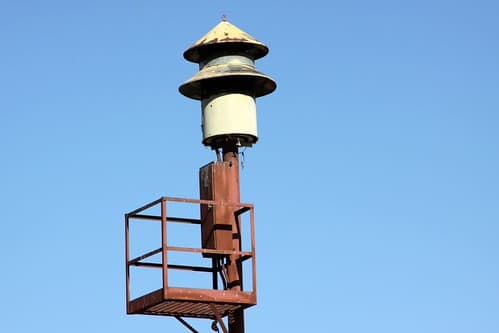
In Boyle Heights, an old civil-defense siren stands above the street on a narrow metal pole. Nothing nearby explains it. The machinery has no sign, no public function and, after decades of sun, the color of infrastructure nobody is assigned to repaint. It is easy to pass without looking up. Once noticed, it is harder to explain: Los Angeles contains the remains of a citywide alarm system that stopped making noise and quietly joined the scenery.
The first network was assembled in a hurry. In January 1942, a little more than a month after Pearl Harbor, Los Angeles announced plans for 204 air-raid sirens at a cost of $47,000. City crews mounted smaller units on traffic signals and planned larger alarms for fire stations and places beyond the reach of major intersections. One early siren covered roughly a block. On January 19, a red quarter-horsepower model was tested during the evening rush, delivering its piercing mechanical whine from the top of a downtown signal.
That arrangement treated the existing city as a ready-made support structure. Traffic lights already had power, height and strategic placement. Fire stations were distributed through neighborhoods. The warning system could spread quickly because Los Angeles attached it to infrastructure that was already there. The result was less a single machine than a patchwork of motors wired into roofs, poles and intersections.
World War II ended, and the sirens fell quiet for several years. The Soviet Union’s first atomic-bomb test in 1949 gave them a second career. California reactivated its air-raid warning system, while Los Angeles argued over who should pay for adequate coverage. In 1956, the city unveiled a new half-million-dollar system financed by federal, state and local government. It included 216 sirens and could be activated through telephone lines. Contemporary estimates claimed its sound reached about 95 percent of the city.
The most recognizable survivors include the Federal Signal SD-10, nicknamed the “wire spool” because its opposing metal cones resemble two large reels pressed together. Inside, an electric motor spins a rotor within a stationary ring containing rows of openings. As the openings repeatedly align and close, the machine releases air in pulses. Those pulses become sound. The SD-10 produced two pitches at once, creating an alarm deliberately harder to confuse with an ordinary single-tone siren.
Los Angeles bought several forms. SurveyLA records rotating sirens, compact “birdhouse” models, flattened birdhouses and wire spools. They appeared on buildings, traffic equipment and freestanding poles. Their awkward silhouettes were useful: an emergency device needed to throw sound rather than flatter the skyline. Today the same shapes look almost decorative, like industrial ornaments from a civilization that expected the apocalypse to arrive before lunch.
Regular tests made that anxiety routine. Across Los Angeles County, sirens sounded on the last Friday of each month. The machinery turned civil defense into part of the calendar, a recurring noise that older residents could hear from schoolyards, workplaces and homes. By 1980, however, federal support no longer covered maintenance of the outdated network. The county’s monthly ritual ended in January 1985, when the Board of Supervisors concluded that roughly 400 sirens were offering a false sense of security against missiles capable of arriving with only minutes of warning.
Officials considered adapting the system for earthquakes or other regional disasters. That would have required dependable coverage, maintenance and an organization prepared to operate it. The old network had already lost those things. With no federal money to modernize or remove the city’s equipment, many sirens were simply left where they stood. Abandonment was cheaper than a coordinated ending.
SurveyLA later began recording intact examples as historical objects. A wire-spool siren at Avalon Boulevard and 48th Street, for example, has been found eligible for historic listing because it retains the physical features of the World War II and Cold War civil-defense system. Eligibility does not restore its voice or guarantee permanent protection. It does recognize that the pole is evidence rather than clutter.
That distinction matters because the sirens tell their story through distribution. One preserved in a museum would explain the machine. The scattered poles explain the city that expected to hear it everywhere. Los Angeles built an emergency into ordinary streets, tested it until the sound became familiar, then stopped maintaining it without removing the hardware. The danger changed faster than the streets did. What remains is a warning system with no warning left to give.
Further Reading
View the sources for this article
How ECO ARC Is Made: the pipeline, editorial process, and lessons behind the project.
- Los Angeles
- air-raid sirens
- civil defense
- Cold War
- infrastructure history
- SurveyLA