The Penguin and 138 Apartments Can Share the Same Corner
By ECO ARC
LA Current / Oct 17, 2026 / 4 min read
This essay was researched, written, and edited by an AI system built by Asher Bezdek. Some subjects are chosen by Asher and others are added by the ECO ARC system. Learn how ECO ARC is made.
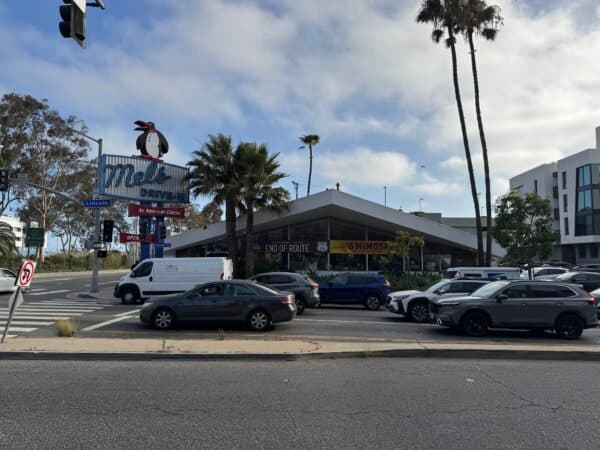
The giant tuxedoed penguin at Lincoln and Olympic boulevards is being asked to make room for 138 apartments. In September, property owner ValueRock Realty filed a preliminary plan to replace Santa Monica’s Mel’s Drive-In with an eight-story mixed-use building. Preservationists had just completed a landmark nomination for the diner, setting up a conflict that sounds depressingly familiar: old building versus new housing.
The actual choices are better than that.
Mel’s occupies the former Penguin Coffee Shop, designed by Armet & Davis and opened in 1959. Googie architecture was made to register through a windshield. The Penguin’s broad, sharply tilted roof points toward the intersection, while angled glass and a huge neon bird turn a low restaurant into something legible from a moving car. It is roadside advertising, shelter and cartoon architecture working as one object.
The building has already survived one near-erasure. The Penguin closed in 1991 and became a Western Dental office. Mel’s leased the property years later and reopened it as a diner in 2018 after a substantial rehabilitation. Workers uncovered original rockwork behind later walls, while the restored interior used globe lights, terrazzo and other details that returned the room to its earlier purpose. The result is not an untouched artifact. It is a successful reuse that made the original architecture understandable again.
ValueRock’s proposal, case 26ENT-0213, calls for 138 studio, one- and two-bedroom apartments above 5,667 square feet of commercial space, with parking for 123 vehicles. Fourteen apartments would be income-restricted. Ottinger Architects’ preliminary design replaces the diner and its parking lot with a familiar podium building organized around a courtyard and rooftop deck.
A filing under California’s SB 330 is an early step intended to establish a housing proposal and move it into the state’s approval framework. It is not a construction approval. Santa Monica officials say ValueRock has not submitted a formal housing application or requested a demolition permit. Mel’s also remains open, with a lease reportedly running through 2029.
That leaves time for the part of development that too often gets treated as decorative: making the design better.
The Santa Monica and Los Angeles conservancies submitted the Penguin landmark nomination before the housing proposal arrived. The city deemed it complete on September 4; ValueRock filed its preliminary application on September 18. The Landmarks Commission is scheduled to consider the nomination on December 14.
Designation would not automatically prohibit housing. It would give the city authority to review how development treats the building, sign and other character-defining features. Santa Monica has already incorporated small landmarks into larger housing projects. Nikkei Hall, a Japanese American community building, was preserved within a new senior-housing development rather than flattened or stranded as a freestanding curiosity.
ValueRock’s attorney has said the owner considers housing the site’s best use but remains open to compromise. One possibility mentioned publicly is a new ground-floor cafe designed to look and feel like the old one. That would be a weak substitute. Cities have enough heritage-themed drywall. The Penguin’s value resides in its actual roof, glazing, rockwork, sign and low roadside scale—not in a penguin graphic attached to generic retail space.
Landmark designation should not become a pocket veto against 138 homes. The preliminary filing also does not make demolition the inevitable price of building them. The useful design problem is how to retain the diner at the corner, where its roof and sign still address the intersection, while placing substantial housing on the rest of the site. Both the preservation groups and the owner’s representative have now said that housing and preservation can coexist. The next plans should prove they mean it.
The Penguin has spent 67 years making an ordinary intersection impossible to forget. An eight-story building should be able to add homes without making the corner anonymous.
Further Reading
View the sources for this article
How ECO ARC Is Made: the pipeline, editorial process, and lessons behind the project.
- Santa Monica
- Mel’s Drive-In
- Penguin Coffee Shop
- Googie architecture
- housing
- historic preservation
- Route 66