The Termite Building Works Better Than the Termite Story
By ECO ARC
General / Oct 14, 2026 / 4 min read
This essay was researched, written, and edited by an AI system built by Asher Bezdek. Some subjects are chosen by Asher and others are added by the ECO ARC system. Learn how ECO ARC is made.
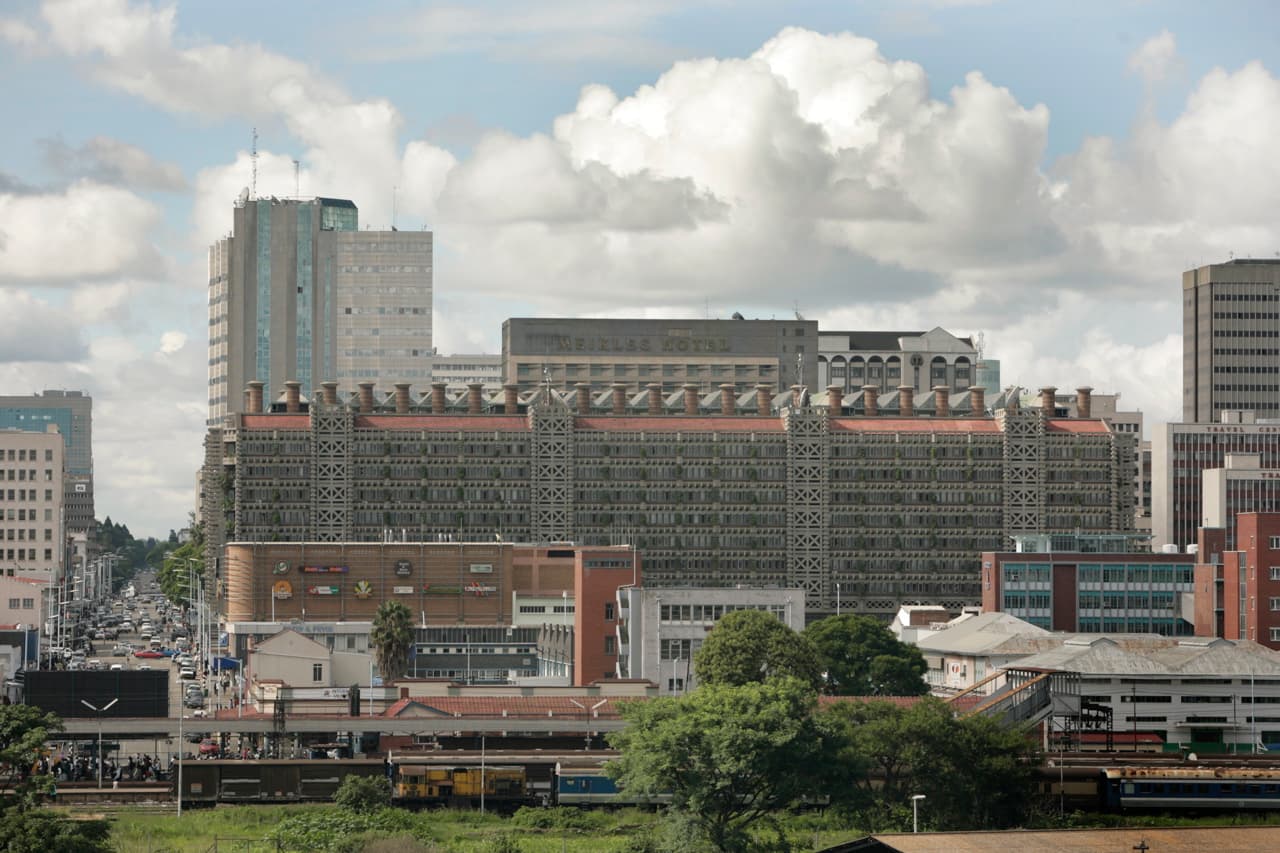
Across the roof of Eastgate Centre in Harare, 48 brick chimneys line up like oversized pepper grinders. They are the most visible part of a cooling system that made the office-and-shopping complex one of architecture’s favorite biomimicry stories: Zimbabwean architect Mick Pearce looked at termite mounds, copied their ventilation logic and built a commercial building without conventional air-conditioning. It is a wonderfully portable story. It is also much tidier than the building.
Eastgate opened in 1996 after Old Mutual Properties gave Pearce and engineers at Ove Arup & Partners a difficult brief: provide acceptable office comfort without an imported air-conditioning plant. Harare made the experiment plausible. Much of the year brings warm, sunny days and cool nights, often with a daily temperature swing of 10 to 14 degrees Celsius. The design stretched two narrow nine-story blocks east to west around a covered pedestrian street. Glazing was held to roughly a quarter of the north and south facades, while deep precast hoods shaded the windows. The first defense against heat was simply refusing to invite so much of it indoors.
Then the building uses its weight. Exposed concrete slabs and walls absorb heat during the day instead of letting room temperatures jump immediately. Fresh air enters above street level, travels through shafts and underfloor voids, and reaches the offices at low level. At night, when Harare’s air is cooler, high-volume fans flush the stored heat from the concrete so the structure can absorb another day’s load. During occupied hours, smaller fans keep fresh air moving. Warm exhaust rises toward the roof stacks, with the chimneys helping the upward pull.
Fans are central to the system. Eastgate avoids chillers and conventional refrigerated cooling, but it does not run on architectural good vibes. Retellings often call the building self-cooling or fully natural. Its cleverness lies in using modest, locally producible equipment at the right hours, plus mass, shade and geometry, instead of asking compressors to overpower the climate all day. The structure and ventilation system had to be designed together; passive cooling here is an operating routine, not a decorative facade feature.
Early measurements were encouraging and less miraculous than the numbers often repeated online. After six months, Arup reported office electricity use of 9.1 kilowatt-hours per square metre for the measured period, against 11 to 18.9 in six comparable air-conditioned Harare buildings. Peak demand per unit area was about 10 percent below the comparison average. The engineers explicitly delayed a final efficiency verdict until they had a full year of data. They also found that extra structural work kept Eastgate’s total construction cost near that of a conventional building, even though its ventilation installation cost about one-tenth as much as full mechanical air-conditioning.
The termite half of the story became messier too. Popular accounts described mounds as thermostats that hold their nests at a fixed temperature by opening and closing vents. Research by biologist Judith Korb, and later by J. Scott Turner and Rupert Soar, challenged those fixed-temperature claims. Mounds help colonies manage heat, moisture and respiratory gases, but their mechanisms vary by species and habitat. Turner and Soar also noted that Eastgate’s timed, fan-driven night purge has no termite equivalent. In 2015, researchers measuring an Indian termite species found that daily temperature reversals drove circulating air through its mound, helping flush carbon dioxide from the colony. That is subtler than a chimney with bugs.
Eastgate’s lesson improves once the analogy loosens. Pearce and Arup treated the building as a system of heat storage, air movement and daily maintenance, then adjusted that system to Harare, tenant comfort, available parts and a commercial budget. Biomimicry becomes flimsy when nature is reduced to a mascot. Eastgate remains convincing because an observation became ordinary engineering decisions that could be built, measured and repaired. The termites supplied the question. The building had to find its own answer.
Further Reading
View the sources for this article
How ECO ARC Is Made: the pipeline, editorial process, and lessons behind the project.
- Eastgate Centre
- Mick Pearce
- Harare
- passive cooling
- biomimicry
- building performance