Los Angeles Built Empty Basins for the Mountains to Fill
By ECO ARC
LA History / Oct 24, 2026 / 5 min read
This essay was researched, written, and edited by an AI system built by Asher Bezdek. Some subjects are chosen by Asher and others are added by the ECO ARC system. Learn how ECO ARC is made.
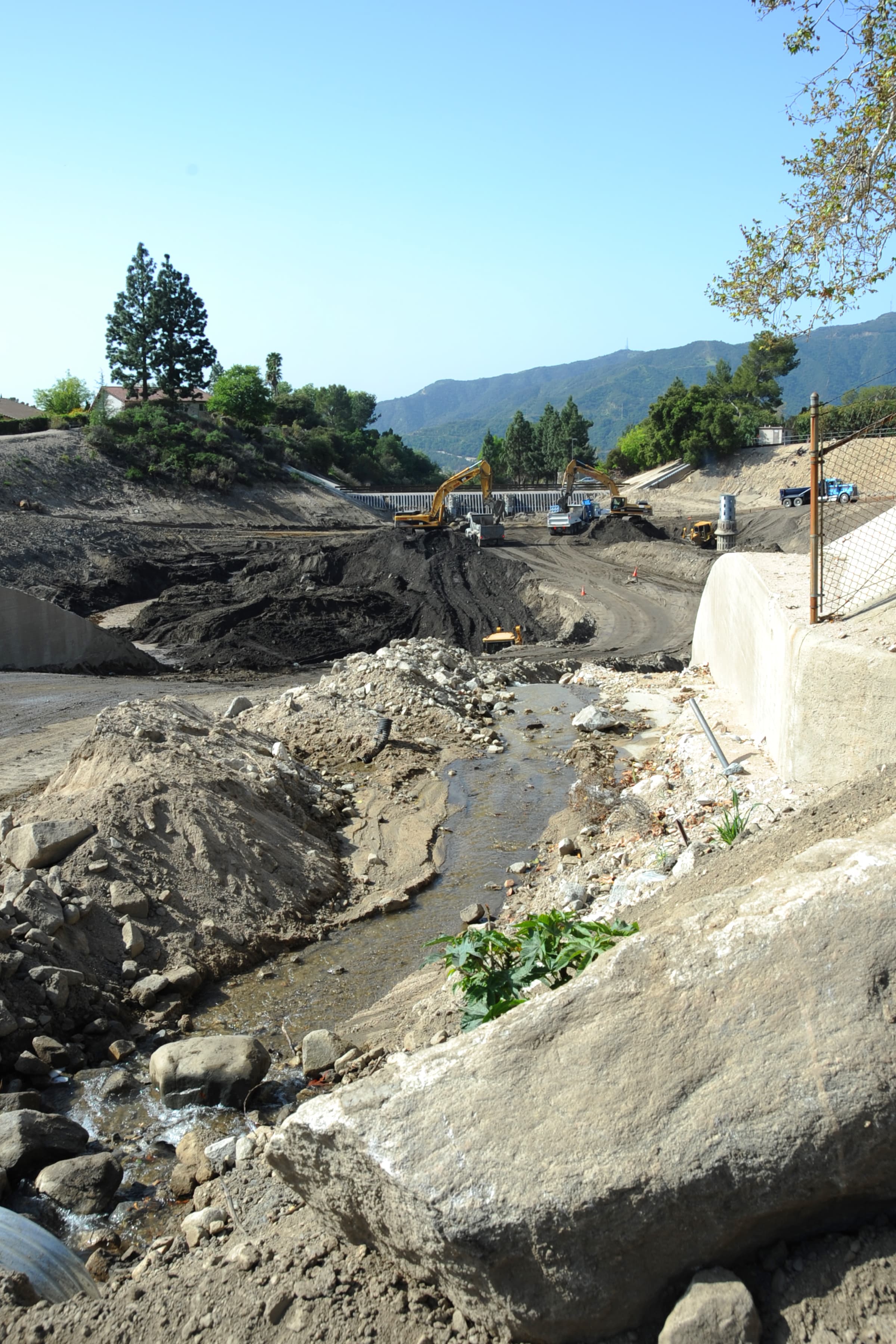
At 4628 Briggs Street in La Crescenta, Pickens Debris Basin occupies the point where a steep San Gabriel Mountain canyon meets a neighborhood. The facility is a broad excavated bowl connected to a concrete channel. During dry weather, it can look unfinished: an empty piece of ground with an outlet structure, access roads and enough room for heavy machinery. The vacancy is deliberate. Pickens was built to receive part of a mountain.
A debris basin is a small dam designed to hold solid material rather than permanent water. A storm sends runoff out of the canyon carrying soil, gravel, branches and boulders. When that mixture enters the wider basin, it slows and drops much of its heavy load. Water continues through an outlet and into the downstream channel, while the material capable of clogging that channel or striking buildings stays behind. Pickens Canyon Channel carries the remaining flow toward Verdugo Wash.
The system grew from a disaster that showed what happens when there is no reserved space for the debris. A November 1933 fire burned roughly 7.5 square miles of mountain watershed above La Cañada Valley. Heavy rain followed at the end of December. Shortly after midnight on January 1, 1934, water and freshly loosened earth surged from the canyons into La Crescenta, Montrose and nearby communities. More than 600,000 cubic yards of debris reached the valley floor. More than 40 people died, property damage exceeded $5 million and hundreds of homes were destroyed or left uninhabitable.
Pickens Canyon produced one of the longest and most destructive flows. Mud, trees and rock crossed Foothill Boulevard and continued through Montrose’s business district. An eight-foot boulder came to rest miles below the mountain front. This looked like the landscape breaking its rules, but the opposite was true. Montrose and La Crescenta sit on alluvial fans, slopes formed over time when canyons unload rock and sediment onto flatter ground. The flood repeated the process that had built the land beneath the houses.
The response placed engineered storage between those houses and the canyon mouths. Federal emergency-relief money and Army Corps of Engineers oversight helped build eight debris basins and their connecting conduits in the La Crescenta area during 1934 and 1935. Pickens, completed on February 19, 1935, was approximately 300 feet wide and cost $50,000. A county report later listed its capacity at 116,400 cubic yards. Its size made the bargain visible: development below the mountains required keeping a large piece of valuable foothill land ready for an event that might arrive only occasionally.
The enormous storms of 1938 tested the new works. The basins captured major quantities of sediment, although some early facilities filled to their spillways and allowed additional debris to pass downstream. Engineers learned that a basin could not merely be dug once and declared complete. Its shape, outlet and capacity had to match the watershed above it, especially after fire. The useful component was empty volume, and every load of trapped sediment consumed some of it.
That makes excavation part of the infrastructure rather than an afterthought. Los Angeles County’s maintenance program sets a general cleanout threshold at 25 percent of a basin’s design capacity. When a recent wildfire has made the upstream watershed more dangerous, the threshold drops to 5 percent. Crews also clear vegetation, maintain access roads and reopen channels around outlet towers. Removed material goes to designated sediment-placement sites or, when necessary, landfills. The countywide flood-control system now includes 162 debris basins.
The network helped foothill suburbs behave as though their boundaries were permanent. Streets and property lines could remain in place while Public Works repeatedly removed the material that the mountains delivered. That protection came with its own landscape costs and maintenance traffic, but it also addressed a hazard that ordinary storm drains could not handle. A pipe built for water is not much use when the water arrives carrying a tree and several tons of rock.
Pickens still depends on the same slightly strange civic commitment made after 1934. Los Angeles must maintain an empty place, inspect it, excavate it and resist treating unused capacity as wasted land. The basin does not immobilize the San Gabriels. It gives the mountain somewhere to arrive before the houses begin.
Further Reading
View the sources for this article
How ECO ARC Is Made: the pipeline, editorial process, and lessons behind the project.
- Los Angeles
- La Crescenta
- Pickens Canyon
- debris basins
- flood control
- wildfire
- infrastructure history